Most people buy a no-pull dog harness, clip the leash to the first ring they can find, and then spend three months getting dragged past the same fire hydrant. I have fitted more than 3,000 dogs at a shelter and inside my own training business, and the pattern almost never changes. The harness is fine. The fit is wrong. Nobody ever showed the owner where the straps are supposed to sit.
A no-pull dog harness is a lever, not a magic vest. When your dog hits the end of the leash, a front attachment point turns that forward momentum sideways and your dog ends up facing you instead of facing the horizon. That only happens if the front strap sits low on the chest and stays there under load. If the harness rotates toward the armpit, you have bought a fancy collar with extra steps.
This guide covers the two harness jobs most owners actually have: walking a dog that pulls, and driving with a dog who thinks the center console is their seat. Then it walks through the fit, in order, the way I do it in a client's driveway.
Why you should trust me
Eight years working with reactive and pulling dogs at a shelter, then a training business in Portland, Oregon, where most clients call me because their dog has learned that a leash is a suggestion. I keep a shelf with more than 30 harnesses on it. They have been washed until the webbing faded, yanked on by dogs that outweigh some of my clients, and worn by my own two German shepherds on the same trails where I test everything else. I do not care what the box says. I care about strap webbing, buckle metal, and whether the padding is still where it was sewn after a month of Pacific Northwest rain.
What "no pull" actually means
There is no harness that teaches a dog not to pull. There is a harness that makes pulling mechanically awkward, plus the training you do while the dog wears it. Both parts matter, and skipping the second one is why so many people end up back at the pet store.
A front-clip design works because of physics, not marketing. Clip the leash to the chest attachment and a dog that surges forward gets rotated back toward you. Clip the leash to the back attachment and the same dog gets a sled dog setup: the load lands on the strongest part of their body and pulling becomes more comfortable, not less. On a 70-pound dog that pulls, a back-clip harness is not a training tool, it is a towing hitch.
Two things have to be true for the front attachment to do its job. The chest strap has to sit low enough that pressure lands on the sternum instead of the throat, and the harness has to be snug enough that it cannot rotate around the ribcage. A loose front-clip harness is worse than a tight back-clip one, because the dog learns that lunging makes the strap slide sideways, and then they lean into it.
How I evaluate a harness before it goes on a client's dog
Every harness that comes through my door gets the same pass.
Fit points. I check three: the chest plate, the shoulder opening, and the girth strap. A harness can match the size chart perfectly and still fail on all three, because size charts measure one number and dogs are not one number.
Hardware. Buckles and load-bearing rings. I have bent plastic D-rings with my thumb. Anything rated for a dog over 40 pounds needs metal at the points where the leash pulls.
Padding. Padding that shifts after a month is worse than no padding at all, because the bare webbing underneath rubs raw spots while the owner still thinks the harness is cushioned.
The car question. Most dogs need two harnesses. The industry pretends one does both, and the compromise usually shows up in a crash test nobody runs.
The walking harness
This is the one your dog wears four times a day. It has to survive mud, rain, and a hundred washes, and the front attachment has to be positioned where your dog's chest actually is.
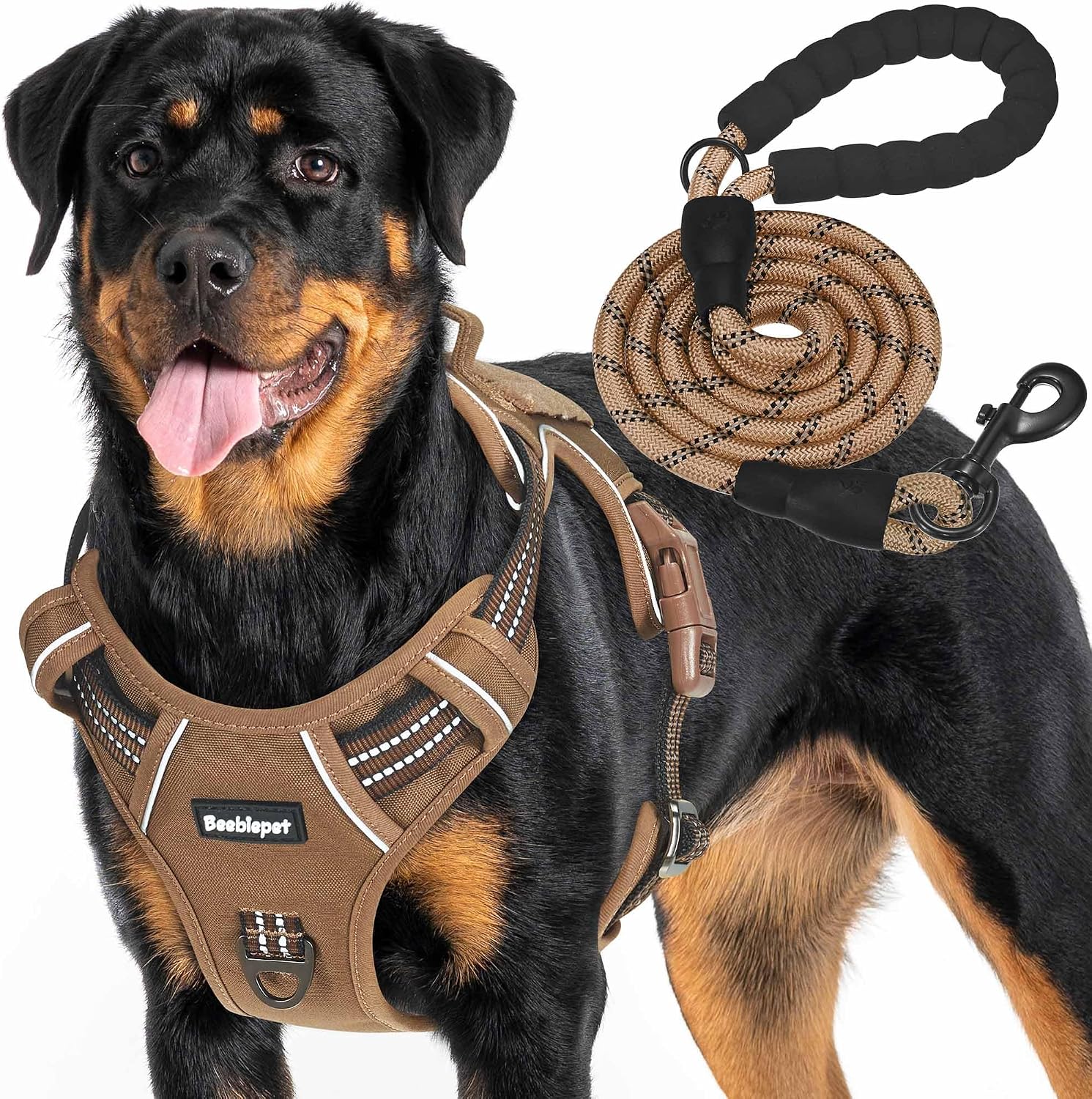
Our pick for daily walks: Beebiepet Tactical No Pull Dog Harness with Leash, X-Large, Brown
 Visit on Amazon →
The reason this one earns the walking slot is the combination in the name: a no-pull design and a leash in the same box. That matters more than it sounds, because half the harness returns I see come from people who bought a harness, discovered their old leash hardware would not sit right on the front ring, and gave up. Shipping a matched leash removes that failure point.
The X-Large sizing is aimed at dogs that max out a medium, which is exactly the dog that tends to pull hardest. If your dog is between a medium and this, size up and take in the straps rather than squeezing into a smaller shell. The brown tactical build is heavier than the flat nylon harnesses in the same class, which is what you want on a dog that leans.
Flaws but not dealbreakers: An X-Large harness has more webbing to manage, so the first fitting takes longer and the straps need trimming or a strap keeper so nothing dangles. Tactical styling also picks up burrs and foxtails on trail walks, so brush it out after hikes.
Anyone walking a strong, medium-to-large dog who wants one purchase that covers the harness and the leash should start here.
The car harness
Car harnesses are a different product with a different job. A walking harness is fitted for shoulder clearance so your dog can trot. A car harness is fitted to hold a dog in place when the vehicle stops faster than the dog expects, which means snug, and the tether has to be short enough that your dog cannot climb into the front seat.
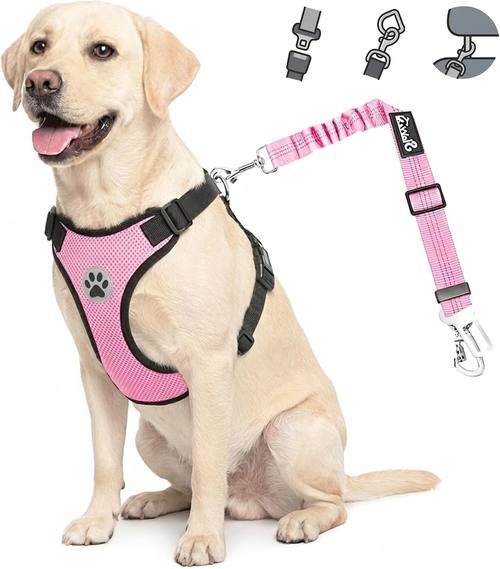
Our pick for the car: Lukovee Dog Car Harness Seat Belt, Harness & Seatbelt with 2 in 1 Buckle
 Visit on Amazon →
The 2 in 1 buckle is the feature that puts this in the car slot. It lets one harness serve as the seatbelt harness and the walking harness without you swapping hardware at the trailhead, which sounds like a small thing until you are standing in the rain with a dog who has already spotted the squirrel.
Fit it the same way you fit a walking harness, then add one extra check: buckle your dog in and pull the tether snug. Your dog should be able to sit, stand, and lie down. They should not be able to reach the front seat, and they should not be able to turn around and get the tether wrapped around a leg. If they can, the tether is too long or the harness is too loose at the girth.
Flaws but not dealbreakers: A car harness used as a walking harness will not give you the same shoulder clearance as a dedicated walking fit, because the girth strap sits tighter. Fine for a trip to the vet and back, not my first choice for a two-hour hike.
Anyone who drives with a dog and is tired of an elbow in the ribs at every stoplight will get their money's worth.
How to fit a no-pull harness, step by step
Now the part you came for. Do this in order, and do it with your dog standing on a hard floor, not on a couch where their weight shifts around.
Step one: Measure the girth, not the neck. Run a soft tape around the deepest part of the ribcage, right behind the front legs. That number is the one that decides sizing. Neck measurements are mostly noise on harnesses that adjust at the neck anyway. If your dog lands between two sizes, size up and tighten the straps. You cannot add webbing that is not there.
Step two: Find the chest plate. The padded piece that sits across the front should rest on the breastbone, roughly a hand's width below the throat. If it rides up against the windpipe, loosen the neck straps and shorten the chest straps until it drops. A harness pressing on the throat will make your dog cough on the first hard pull, and they will start pulling harder to get away from the pressure.
Step three: Check the shoulder opening. With your dog standing, slide two fingers under the strap that runs behind the front leg. Now walk them a few steps. The opening should stay clear of the armpit. If the strap saws into the armpit with every step, the harness is too small, or the chest strap is too long and dragging the whole assembly forward.
Step four: Apply the two-finger rule, then try to break it. Two flat fingers under every strap is the starting point, not the finish line. Once everything passes, grab the harness at the back and try to rotate it over the shoulders. If it spins with light pressure, take in the girth strap. A harness you can twist like a t-shirt is going to slide sideways the moment your dog lunges.
Step five: Load it up. Clip the leash to the front attachment and put steady pressure on it, the way your dog will when they see a squirrel. Watch three things: does the chest plate stay on the sternum, does the girth strap stay behind the ribs, and does the front ring stay centered. If the whole harness rotates toward one shoulder, tighten the girth strap one more notch and shorten the strap on the side it slides toward.
Step six: Walk 20 minutes, then check for rubs. Take the harness off and run your hands over the armpits, the sternum, and where the girth strap crosses the ribs. Pink that fades in ten minutes is normal. A raw spot or a matted patch of fur means the fit is wrong, not that your dog needs a sweater. Adjust before the next walk.
Step seven: Repeat the whole check monthly. Puppies change shape every few weeks. Adult coats thicken in winter and thin out in spring. A harness that fit in October can be sloppy by February, and sloppy is how a front-clip harness stops working.
Fitting mistakes that make a good harness fail
Buying one size too big. Loose is the most common failure I see. Owners size up "so there's room to grow," and the harness rotates on every walk. Front-clip harnesses need contact.
Clipping the leash to the back ring and calling it a no-pull harness. The back ring is for a dog that already walks politely. If your dog pulls, the back ring teaches them that pulling pays.
Letting the chest strap ride high. If the front strap sits at the base of the throat, you have moved the pressure from the sternum to the windpipe. Shorten the chest straps and recheck.
Using the car harness for everything. Car harnesses are fitted tighter on purpose. Walk a dog in that fit for an hour and you will find rub marks in the armpits. Two harnesses, two jobs.
Ignoring the padding. If the padding bunches to one side after a wash, fix it or the bare webbing will do the rubbing. Padding that traps fur and mats it is its own problem, so brush your dog after every walk in shedding season.
What this all costs
The honest answer is that the money math is not the interesting part. A walking harness that fits properly gets used four times a day, and a car harness gets used every time the dog rides. Divide either one by a year of daily use and the per-day number is smaller than the treat you hand over at the end of the walk.
What costs real money is the cycle of buying the wrong size, blaming the product, and buying another one. Measure the girth first, fit the chest plate and shoulder opening second, and you break that cycle at the first purchase instead of the third.
Check current Amazon price on the Beebiepet for the walking slot and the Lukovee for the car slot, then do the seven-step fit before your first real walk. Your dog's shoulders will tell you within a block whether you got it right. When the harness stops rotating and the front attachment stays on the sternum, the pulling gets awkward for your dog and easy for you, which is the entire point of the tool.